**Summer Sale - $100 Off Per Container (Purchase Only) - Buy Now!**


When is a Shipping Container Retired?
Learn why and when shipping containers are retired from sea service—and how they get a second life on land.

A shipping container is “retired” or “decommissioned” from a shipping vessel when it is no longer considered economically viable, or compliant with current international shipping standards. While no universal expiration date exists, most containers reach retirement after years of heavy use, exposure to harsh environments, or changes in regulatory requirements. Understanding [why and when containers are retired](https://www.eveoncontainers.com/en-US/resources/shipping-container-types-and-specifications) helps explain how they can still offer value in a second life on land.
## Why decommission containers?
- **Regulation:** Stay compliant with international maritime laws & classification standards
- **Efficiency:** Avoid delays caused by failing inspections or cargo being rejected
- **Cost-effectiveness:** Older or damaged containers are often more expensive to maintain than to replace
- **Quality control:** Pulling certifications after a number of years ensures that a fleet will have the most up to date and highest quality containers at all times are being used for transport
## When is a container decommissioned?
### 1. Age Limit
- Typically, after 10–13 years of use, though this varies depending on usage and maintenance.
- Some may last up to 20 years with good upkeep.
- Containers can service land-based purposes for decades with proper maintenance.
### 2. Failed Inspection or Certification
- Containers used for international shipping need valid CSC (Convention for Safe Containers) certification.
- If a container fails inspection due to damage, rust, or structural issues and is not worth repairing, it’s [retired](https://www.npsa.org/portable-storage-containers.html).
### 3. Excessive Wear or Damage
- Major structural damage (e.g., warped frames, holes, cracked welds).
- Corrosion, especially around doors and floor sills that would require maintenance and repair at the depot.
### 4. Obsolescence or Design Issues
- Some older containers don’t meet new efficiency or design standards.
- Containers may also be retired if their design doesn't fit with modern handling equipment.
### 5. Economic Reasons
- Repair costs outweigh container’s residual value.
- Cheaper to retire and sell for storage, conversion, or modification.

## What is a CSC Plate or Certification?
A CSC plate (short for Convention for Safe Containers plate) is a safety approval plate found on shipping containers. It’s a metal plate affixed to the container that certifies the container meets international safety standards for use in international transport.
The CSC plate is part of the [International Convention for Safe Containers (CSC)](https://www.imo.org/en/About/Conventions/Pages/International-Convention-for-Safe-Containers-(CSC).aspx), an agreement established by the [International Maritime Organization (IMO)](https://www.imo.org/) to ensure containers are safe for handling and transport.
It is usually bolted to the container door, often on the left-hand door, or another clearly visible location and proves that the container is qualified for international transport.
Containers Continue to Serve on Land
Once decommissioned, used shipping containers often get a second life as:
- Onsite portable [storage](https://www.eveoncontainers.com/en-US/shipping-containers-for-onsite-storage) units
- Offices, [homes](https://www.eveoncontainers.com/en-US/inside-the-box-with-mcfadden-ridge-rentals), shops
- Emergency [shelters](https://www.eveoncontainers.com/en-US/former-cabinet-maker-and-storm-prepper-billy-clark)
- [Event structures](https://www.eveoncontainers.com/en-US/renowned-polo-farm-enhances-their-vip-experience-with) and offices
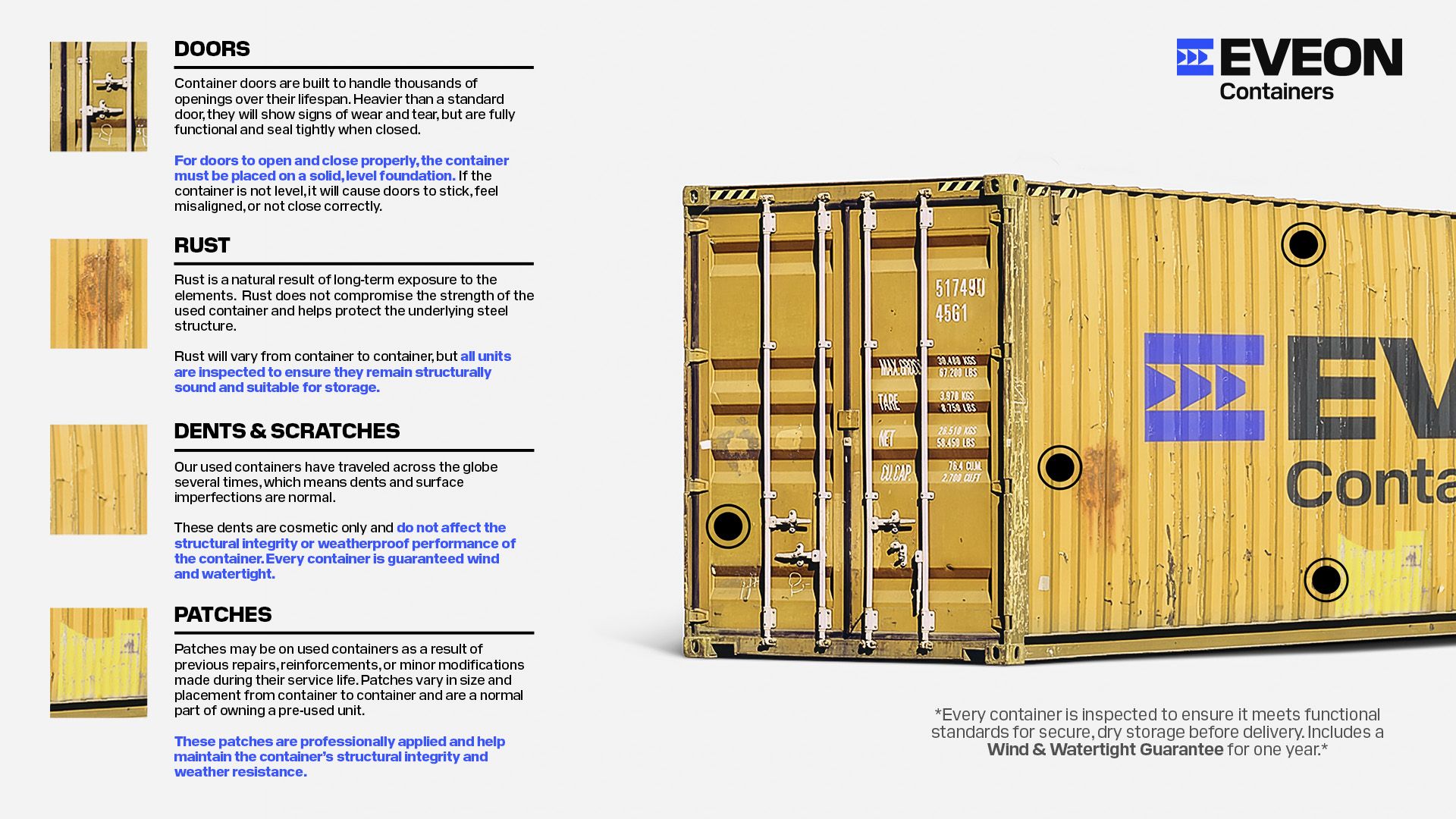
Please note all containers from Eveon are inspected, have gone through M&R and signed off with an inspection form to make sure they are Wind & Watertight. Trusted for years at sea to transport goods, we encourage you explore shipping containers for sustainable storage solutions. All containers delivered and sold from Eveon have passed our [Quality Guarantee](https://www.eveoncontainers.com/en-US/eveon-guarantee) and are ready to serve a land-based purpose for years to come.
**##
What you can expect from a used shipping container from Eveon:**
Frequently Asked Questions
- Currently, we exclusively offer decommissioned containers for land-based storage, construction, and shipping purposes. It's important to note that these containers do not include a CSC certificate.
- The production of new containers causes an incredible amount of CO2 emissions into our atmosphere each year. We made the decision to only sell used containers to [reduce our environmental footprint](https://www.eveoncontainers.com/en-US/sustainability) on the planet. We are in business to make better use of what's already there and put all our energy into extending the lifetime of containers that are already there.
- Eveon Containers offers 20ft, 40ft and 40ft High Cube shipping containers. These containers have lengths (externally) of 20ft or 40ft and 8ft in width as standard. The height of a container will be 8ft 6” for the standard containers. The height of a High Cube (HC) will have an additional foot to be 9ft 6”.